

Legal Pathways to Property Use for Foreigners: Usufruct in the Philippines and Hak Pakai in Indonesia
On this page
- I.Legal Foundations of Usufruct in the Philippines
- II.Legal Foundations of Hak Pakai in Indonesia: Why Not Civil Code Usufruct? Indonesia’s Statutory Departure
- III.Nominee Arrangements and Indonesia’s Enforcement Posture
- IV.Nominee Arrangements and the Philippine Anti-Dummy Law
- V.Comparative Analysis Between Usufruct and Hak Pakai
- VI.Practical Planning Considerations
- VII.Conclusion
For decades, foreigners seeking to live, retire, or invest in property across Southeast Asia have run into the same wall: most countries restrict or outright prohibit foreign land ownership.
In response, a shadow industry of nominee arrangements has flourished — foreigners using local individuals or shell entities to hold title “on their behalf.”
The problem?
In most jurisdictions, this is illegal, and governments are increasingly cracking down.
Indonesia, for example, has begun deporting foreigners involved in these schemes and jailing the local facilitators who helped structure them.
Picture a foreign retiree dreaming of a villa in Bali, or an investor eyeing a family estate in Manila — but local law won’t let them hold outright title. Is the dream dead?
Not necessarily.
Both the Philippines and Indonesia impose strict constitutional limits on foreign land ownership, yet both jurisdictions offer legal mechanisms that let someone use and profit from property without owning it outright.
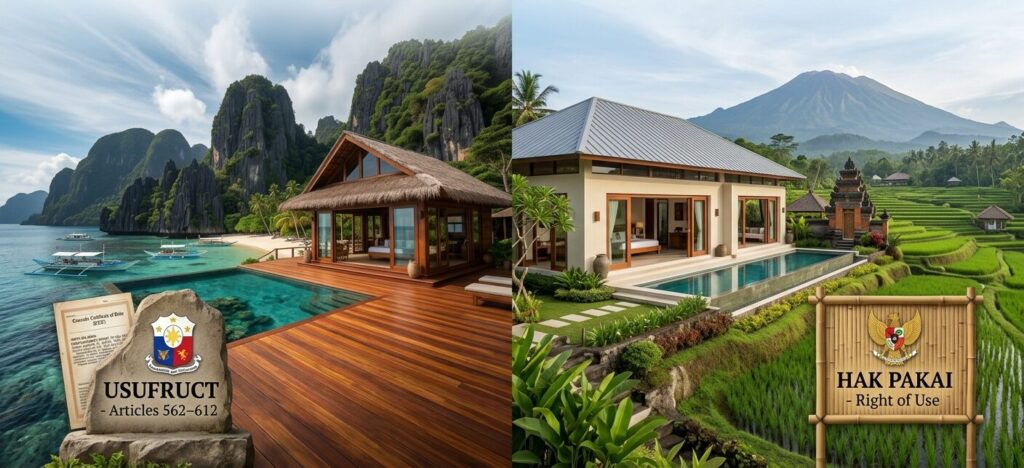
In the Philippines, this mechanism is usufruct, grounded in the Civil Code, Articles 562–612. In Indonesia, the equivalent pathways are Hak Pakai (Right of Use) and Hak Guna Bangunan (Right to Build), grounded in the Basic Agrarian Law (UUPA No. 5/1960) and the Omnibus Law.
These are not the same legal mechanism, even though they look similar on the surface. One is a private civil-law real right; the other is a public agrarian-law statutory grant.
Treating them as interchangeable can cost you money, time, or your entire arrangement.
I. Legal Foundations of Usufruct in the Philippines
Usufruct in the Philippines is rooted in the Civil Code of the Philippines (Articles 562–612), which defines it as a real right granting a person — the usufructuary — the ability to enjoy the property of another, with the obligation of preserving its form and substance, unless otherwise authorized by law or agreement.
This right differs fundamentally from ownership because it separates the enjoyment and use of property from its legal title.
The usufructuary benefits from the property’s fruits, income, or utility, while the underlying title remains with another party, the naked owner.
Usufruct may be created through contracts, donations, wills, or operation of law, and may be established over land, buildings, or other income-producing assets.
Because it does not confer ownership, usufruct is frequently used by families, estate planners, and foreign investors as a flexible tool to allocate benefits without transferring title, particularly where constitutional restrictions prevent foreigners from owning land directly.
Illustrative Case: Long-Term Usufruct for a Philippine Villa
Consider a hypothetical case involving a sixty-seven-year-old Australian retiree holding a Special Resident Retiree’s Visa, who seeks long-term tenure over a beachfront villa in El Nido. Ownership of the land remains with a Filipino citizen or a qualified land-owning corporation. The retiree enters into a formal, notarized Usufruct Agreement with the landowner for an initial period of fifty years, and the agreement is explicitly annotated on the property’s Transfer Certificate of Title.
Under this arrangement, the retiree may build and fully own the villa structure independently of the land itself. Should the landowner later sell the property or pass away, the usufruct remains legally binding on any new owner or heir for the full fifty-year term. This enforceability against successors in interest — achieved through formal registration — is what distinguishes a lawful usufruct from an informal or undocumented arrangement that would offer no such protection.
A usufructuary enjoys broad rights, including the right to possess the property, enjoy its natural, industrial, or civil fruits, and lease it out or otherwise derive income from it, unless expressly prohibited by the instrument creating the usufruct.
These rights carry corresponding obligations: the usufructuary must care for the property with the diligence of a good father of a family, must not alter its substance or character without consent, and is generally responsible for ordinary repairs and maintenance. The naked owner retains the right to dispose of the property, to mortgage it, and to recover it in substantially the same condition once the usufruct terminates, but may not interfere with the usufructuary’s enjoyment during the life of the right.
Usufruct may be established for a definite period, for the lifetime of the usufructuary, or in favor of a juridical entity, in which case the law imposes a maximum duration of fifty (50) years. It terminates upon the (i) death of the usufructuary if granted for life, (ii) upon expiration of the agreed period, (iii) upon loss or total destruction of the property, (iv) upon merger of the usufruct and ownership in the same person, or (v) through renunciation.
The creation of usufruct may trigger donor’s tax if gratuitously established. Income generated by the usufructuary, such as rental income, is generally subject to income tax in the hands of the usufructuary. Real property tax typically remains with the naked owner unless otherwise stipulated, though many arrangements shift this obligation to the usufructuary as part of maintenance duties. Estate planners often use usufruct to manage estate tax exposure, transferring naked ownership to heirs while retaining usufructuary rights during the original owner’s lifetime.

II. Legal Foundations of Hak Pakai in Indonesia: Why Not Civil Code Usufruct? Indonesia’s Statutory Departure
A natural question, particularly for advisers accustomed to civil law systems, is whether Indonesia — with its Dutch colonial legal heritage — recognizes an equivalent to true usufruct. The Indonesian Civil Code, inherited from Dutch law, does contain the concept of vruchtgebruik, or usufruct, as a private-law right.
However, this civil-code usufruct does not apply to land. When Indonesia enacted the Basic Agrarian Law No. 5 of 1960 (UUPA), it nationalized and unified all land-related tenure under a single statutory hierarchy, superseding colonial-era civil property concepts as they relate to land.
Structuring a land arrangement using civil-code vruchtgebruik is therefore legally unreliable, since Indonesian courts and land registries apply the UUPA framework regardless of how a private contract is labeled.
The correct, recognized vehicle for foreigners is Hak Pakai — a public-law right to use, created and administered under agrarian statute rather than private civil contract.
Indonesian law prohibits foreigners from holding Hak Milik, or freehold title, which is reserved exclusively for Indonesian citizens under Article 21 of the UUPA.
Hak Pakai sits within a broader hierarchy that includes Hak Milik, or full ownership; Hak Guna Usaha, or cultivation rights; Hak Guna Bangunan, or building rights; and Hak Pakai, or right to use.
It is the primary mechanism through which foreign individuals meeting residency requirements, and foreign entities with legal presence in Indonesia, may lawfully hold rights over land. This framework was modernized under Government Regulation No. 18 of 2021, which permits foreign individuals holding valid stay permits, such as a KITAS (temporary residency) or KITAP (permanent residency), to register Hak Pakai directly under their personal names for residential properties.
Holders of Hak Pakai are granted the right to use and occupy land for a specific purpose, residential, commercial, or otherwise, as specified in the granting decree or agreement.
Unlike usufruct, which may be created through purely private contract, Hak Pakai is typically granted by the state or through formal agreement with a Hak Milik holder, and must be registered with the National Land Agency to be legally recognized and enforceable against third parties. Holders may generally construct buildings, lease the property, or use it commercially, subject to the terms of the grant, but may not transfer the underlying land title itself. Obligations include paying applicable land and building taxes, complying with zoning regulations, and using the land strictly for its designated purpose; deviation may result in revocation.
The applicable duration depends on who granted the right. Hak Pakai over state land is typically issued for an initial period of up to thirty (30) years, extendable for an additional twenty (20) years, and renewable for another thirty (30) years, allowing a holder to enjoy rights over the land for up to eighty (80) years in total through successive renewals, provided all legal and administrative requirements are met.
When Hak Pakai is granted over land privately owned by a Hak Milik holder, the far more common scenario for individual foreigners purchasing a villa or residential property, the duration is capped under current regulations at an initial maximum of thirty (30) years, renewable only once for another thirty (30) years, establishing a sixty-year (60) maximum lifecycle ceiling. Upon expiration without renewal, the right reverts to the state or the underlying Hak Milik holder, making timely renewal a critical consideration for long-term investors and foreign residents.
Hak Pakai holders are subject to the Land and Building Tax, calculated on assessed value regardless of whether the holder possesses full ownership or merely a right to use.
Rental or other income derived from the land is subject to income tax, with the applicable rate depending on whether the taxpayer is an individual or corporate entity.
When Hak Pakai is acquired through a transaction with an existing landowner, the transfer may trigger the Duty on Acquisition of Land and Building Rights, based on transaction value or assessed value, whichever is higher.
Foreign individuals should also remain mindful of potential tax reporting obligations in their home jurisdictions.

III. Nominee Arrangements and Indonesia’s Enforcement Posture
Alongside the lawful Hak Pakai framework, a separate and unlawful practice has persisted among some foreign buyers: the use of nominee arrangements, in which an Indonesian citizen holds the paper title to land as Hak Milik while the foreigner controls the property through private side-contracts, commonly an unregistered loan agreement, an irrevocable power of attorney, and a long-term lease stacked together to approximate ownership.
This structure is not a legal gray area.
Under Article 26(2) of the UUPA, any transaction that attempts to indirectly transfer Hak Milik to a foreigner is null and void by operation of law, and the property can revert to state control.
Indonesian courts apply a substance-over-form analysis: where the practical effect of a mortgage, lease, and power-of-attorney package is to give a foreigner the functional rights of ownership while a local nominee holds paper title, courts will look past the contractual labels and treat the arrangement as a disguised, prohibited transfer.
A mortgage-plus-lease structure, sometimes presented as a more sophisticated alternative, carries the same legal defect, because the underlying substance remains indirect foreign control over Hak Milik.
Enforcement has intensified in recent years. Regional regulation, including Bali’s Perda No. 4/2026, has introduced criminal and administrative sanctions targeting both foreign investors and local nominees.
Indonesia’s Ministry of Law and Human Rights has increased audits of regional notaries, restricting practitioners from drafting side agreements designed to mask foreign land control.
Foreigners identified in nominee schemes have faced deportation, while local facilitators have faced criminal liability as accessories to an illegal transfer. When such arrangements are tested in litigation, Indonesian courts have consistently ruled in favor of the registered titleholder, leaving the foreign party without an enforceable claim.
Consider a composite scenario reflecting a pattern reported across Bali’s property market. A foreign investor acquires a beachfront villa valued at approximately five (5) million United States dollars, structured through a nominee: an Indonesian acquaintance holds the Hak Milik title, while the investor relies on a notarized loan agreement, an irrevocable power of attorney, and a twenty-five-year lease to control the property and collect rental income. The arrangement functions for several years, until the nominee passes away unexpectedly. The nominee’s heirs, now the legal titleholders, decline to honor the side-agreements.
When the dispute reaches court, the judge applies Article 26(2) of the UUPA, holding the side agreements void as an indirect attempt to transfer Hak Milik to a foreigner. The investor is left without a registered right, without a compensation mechanism, and without a claim to the villa, resulting in the loss of a seven-figure investment and potential immigration consequences for participation in a prohibited scheme.
This is the risk that Hak Pakai is designed to remove. A registered right under the National Land Agency survives the death of the grantor, a change in ownership, or a change in the grantor’s intentions, because it does not depend on continued cooperation after the fact.

IV. Nominee Arrangements and the Philippine Anti-Dummy Law
Just as Indonesia enforces strict public policy against proxy ownership, the Philippines maintains an equally aggressive stance against hidden foreign property holding. Real estate buyers attempting to bypass constitutional land bans by placing titles under the name of a Filipino citizen – such as a spouse, domestic partner, business associate, or local nominee corporate entity – face severe statutory consequences.
Under Commonwealth Act No. 108, popularly known as the Anti-Dummy Law, it is a criminal offense to use a local citizen as a “front” or dummy to acquire, use, or control land. The law targets “beneficial ownership,” meaning that if a foreign national provides the funding and exercises executive control over the property via private side-contracts (such as simulated lease agreements, hidden loan instruments, or irrevocable powers of attorney), the state treats the transaction as an illegal circumvention of national sovereignty.
The Philippine Enforcement Reality: Void Contracts and Forfeiture
When nominee arrangements are exposed or end up in court due to a personal fallout or estate dispute, the consequences for the foreign investor are severe and irreversible:
Absolute Nullity: The Supreme Court of the Philippines has consistently ruled (including in foundational precedents like Neunzig v. Court of Appeals) that any contracts, mortgages, or side deeds executed to camouflage foreign control are void ab initio (void from the very beginning). Because the agreement itself violates the Constitution, courts will refuse to enforce it.
No Legal Remedy: Under the principle of in pari delicto (both parties being equally at fault), Philippine courts will not assist the foreigner in recovering their money or retaining the house. The foreign buyer cannot sue the nominee for breach of contract or demand a refund, resulting in a total loss of investment capital.
Criminal Liability and Reversion: Violations of the Anti-Dummy Law carry penalties of 5 to 15 years imprisonment, substantial corporate or individual fines, and the immediate deportation of the foreign national. Furthermore, the Office of the Solicitor General (OSG) can initiate reversion proceedings, causing the illegally held land to be forfeited entirely to the state.
This stark legal danger is exactly why structures civil-law instruments like Usufruct are vital. By explicitly registering a usufructuary title on the property’s Transfer Certificate of Title (TCT), a foreign investor moves completely out of the shadow market and into a transparent, legally recognized framework that protects their possessory rights without violating the law.

V. Comparative Analysis Between Usufruct and Hak Pakai
Usufruct is fundamentally a private law concept, created through contracts, wills, or donations between individuals, whereas Hak Pakai is primarily a public law mechanism tied to state land administration and agrarian policy, even though it may also be established through private agreement with a Hak Milik holder.
Usufruct offers broader latitude in structuring terms through private agreement, while Hak Pakai is more standardized and subject to government regulation regarding duration, renewal, and permissible use.
Regarding duration, usufruct may be tied to the lifetime of an individual or capped at fifty (50) years for juridical entities. Hak Pakai’s duration depends on the land’s origin: up to eighty (80) years through successive renewals when granted over state land, or up to sixty (60) years when granted by agreement with a private Hak Milik holder, the latter being the more typical scenario for individual foreign residents and retirees acquiring usage rights toresidential property directly from a local landowner.
From a taxation perspective, both mechanisms impose income tax on the party enjoying use of the property, though usufruct in the Philippines carries a distinct risk of triggering donor’s tax upon gratuitous creation, while Hak Pakai transactions more commonly trigger acquisition-based duties similar to transfer taxes.
Strategically, usufruct is often favored in the Philippines for estate planning, allowing families to manage generational wealth transfer while retaining lifetime benefits, whereas Hak Pakai is the principal lawful avenue for foreign investors and expatriates in Indonesia to secure long-term property interests.
VI. Practical Planning Considerations
For foreign investors considering property interests in either jurisdiction, careful attention must be paid to the specific legal requirements governing creation, registration, and enforcement, since informal arrangements that fail to comply with registration requirements may be unenforceable against third parties.
In the Philippines, investors should work with legal counsel to draft usufruct agreements that clearly specify the scope of rights, maintenance obligations, and termination conditions, while considering potential donor’s tax implications.
In Indonesia, investors must ensure their Hak Pakai grant is properly registered with the National Land Agency and that they remain compliant with the stated land use purpose, since deviation can jeopardize the right entirely.
Both jurisdictions require close attention to renewal timelines, since allowing a usufruct or Hak Pakai to lapse without proper renewal can result in complete loss of property interests.
A foreign retiree residing in the Philippines who wishes to secure long-term use of a residential property owned by a Filipino spouse or family member may establish a usufruct over the property, allowing the retiree to live in and enjoy it for life while title remains with the family member, satisfying constitutional restrictions while providing practical housing security.
A comparable scenario arises in Indonesia for a foreign husband married to an Indonesian wife, where the couple purchases a home in Bali. Because Hak Milik is reserved for Indonesian citizens, the wife holds the freehold title in her own name. Rather than relying on an informal understanding or an unregistered side-letter, which would carry the same legal defects as a nominee arrangement, the couple may formally register a Hak Pakai in the husband’s name, granted by the wife as the Hak Milik holder, with the National Land Agency. This gives the foreign husband a real, registered legal right to occupy the property, lease it, and collect rental income in his own name, enforceable against third parties, for up to sixty years under the private-land track. Should the marriage later dissolve or the wife pass away, the registered Hak Pakai remains a recognized legal interest rather than something dependent on the goodwill of the wife’s heirs.
A further scenario involves a foreign entrepreneur in Indonesia seeking to establish a long-term business presence by constructing a commercial building on leased land. Securing a Hak Pakai grant allows the entrepreneur to legally use the land for commercial purposes for up to thirty years initially, with the possibility of extension and renewal, providing a stable legal foundation for long-term operations despite not holding full ownership of the underlying land.
VII. Conclusion
Usufruct in the Philippines and Hak Pakai in Indonesia represent two distinct yet functionally comparable legal solutions to a common challenge: enabling property use and enjoyment for individuals who cannot hold full ownership rights under their respective national laws.
Usufruct offers greater contractual flexibility, rooted in civil law traditions of private property relations, while Hak Pakai provides a standardized, government-regulated pathway suited to Indonesia’s agrarian land administration system, a system that deliberately excludes civil-code usufruct from applying to land at all.
What both jurisdictions share is that a lawful, registrable alternative to foreign landholding already exists.
There is no legal basis for relying on nominee arrangements, disguised mortgages, or unregistered side-agreements, structures that Indonesian courts have voided and that Indonesian authorities now actively prosecute. For investors, retirees, and the advisers who serve them, the task is not to construct a workaround to foreign ownership restrictions, but to correctly apply the civil-law and statutory tools, usufruct and Hak Pakai, that were designed for this purpose from the outset.

Jeffrey Epstein and Cook Island Structures
Read article
SBA Trusts vs Cook Island Trusts – Which Is Better?
Read article
Brief Overview of Special Tax Regimes in Europe – UK, Ireland, Gilbraltar, Portugal, Spain, Italy, Switzerland, Greece, Cyprus, Malta
Read articleLooking for an international tax service?
We’re always here to help. Don’t hesitate to get in touch.
Talk to an expert